IEEE 14-Bus N−1 Contingency Analysis and Grid-Risk Dashboard
AC outage analysis, islanding detection, transparent severity ranking, and PTDF/LODF screening on a benchmark network.
Executed simulation
Automated test
Problem statement
Identify which single-branch outages most threaten the IEEE 14-bus benchmark while keeping topology failures, voltage criteria, synthetic thermal assumptions, and approximation error auditable.
A reproducible reliability workflow that validates the base case, removes every line and transformer, records violations, and compares fast DC screening with full AC results.
20
N−1 outages
Every line and transformer evaluated exactly once
1
Islanding event
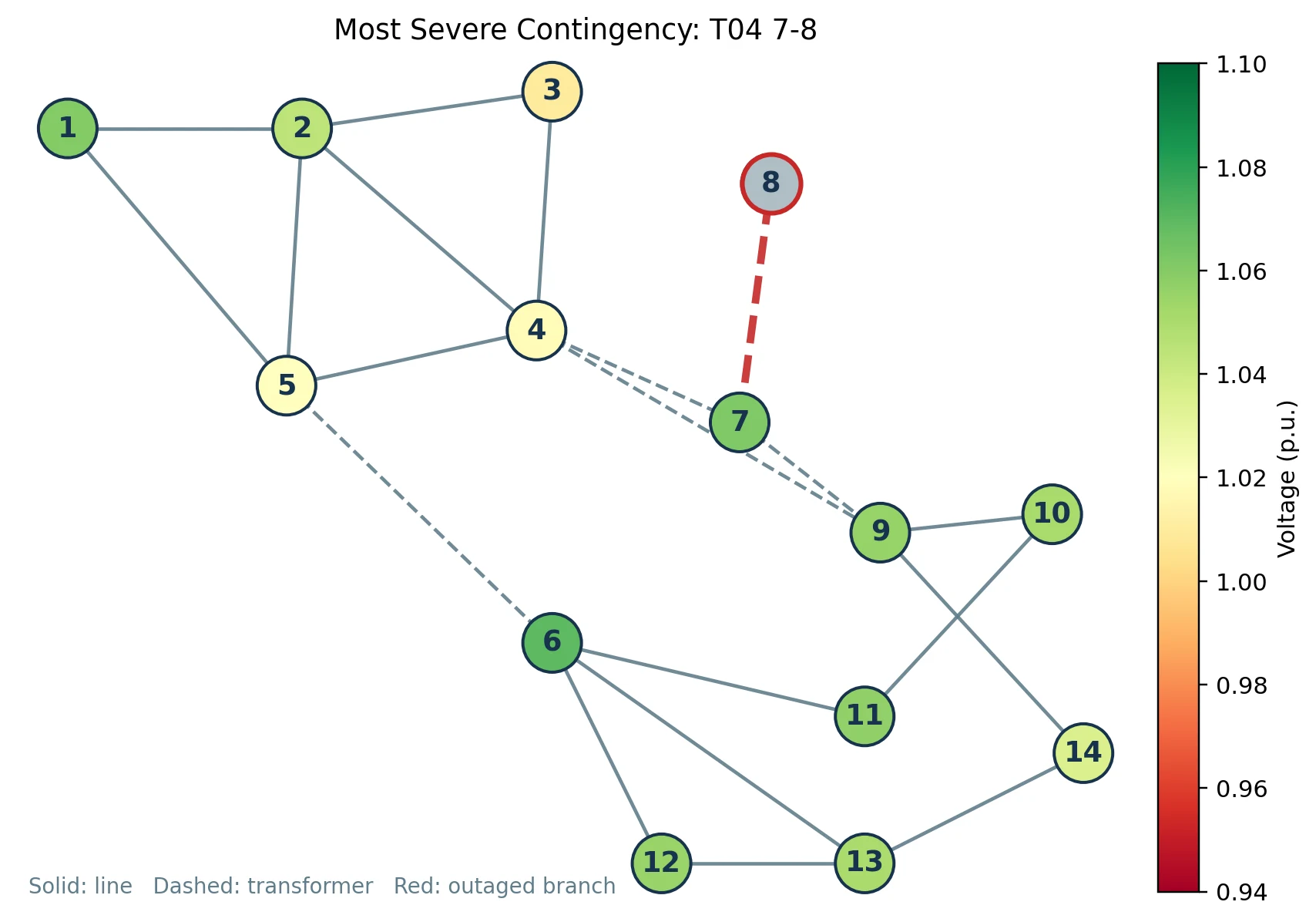
Transformer 7-8 separates bus 8
1.174 MW
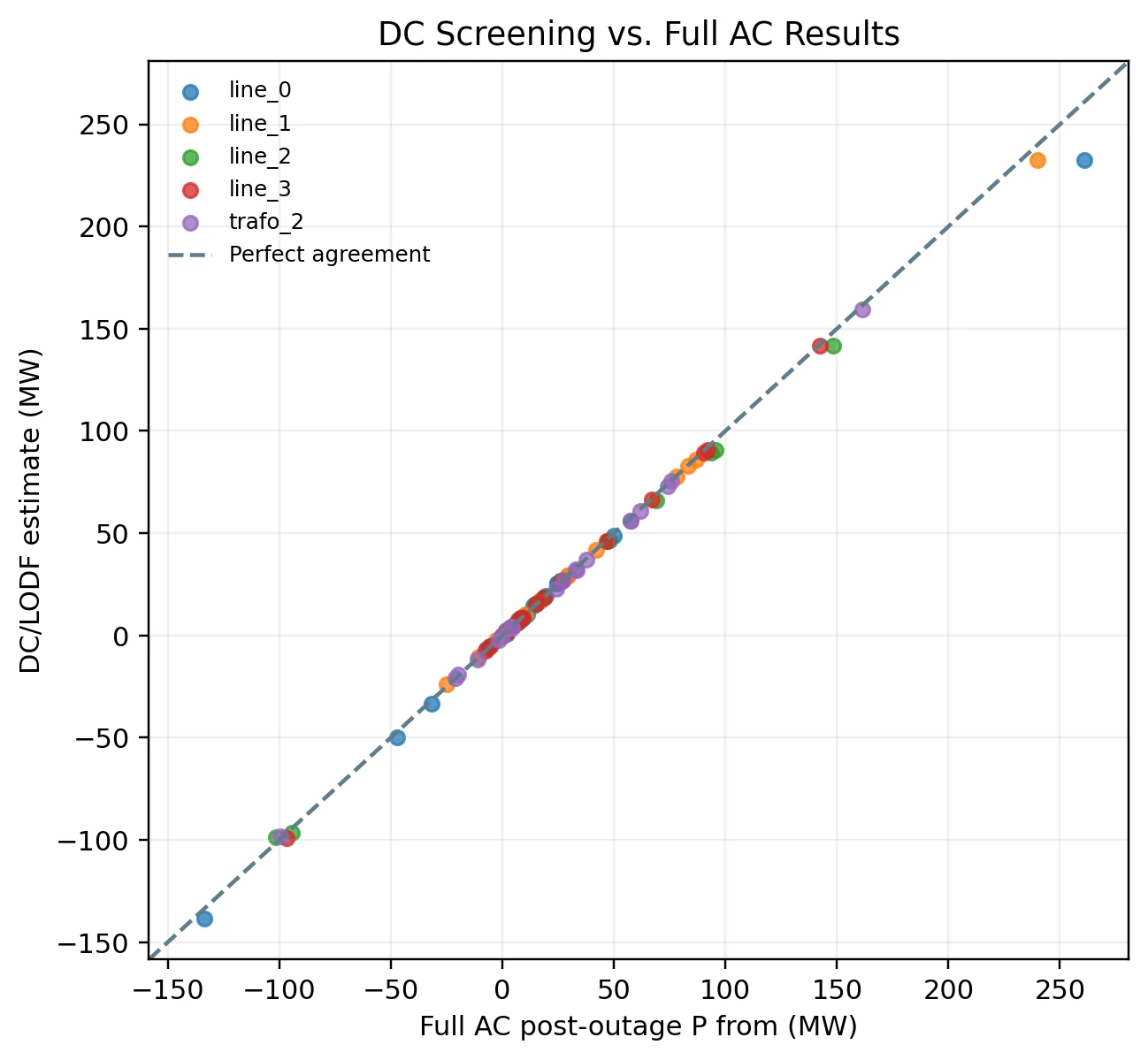
DC screening MAE
Five selected connected outages versus AC branch flows
13.393 MW
Base real losses
Validated AC base case on a 259 MW load
Project scope
14 buses, 15 lines, five transformers, 11 loads, and 20 single-branch outages
Newton-Raphson AC analysis with a fast-decoupled validation solve
Graph-based islanding detection and deterministic severity ranking
Independent PTDF/LODF implementation and selected-case AC comparison
System or processing architecture
A validated AC base model feeds a contingency engine. Each outage is checked topologically before solving; connected cases produce bus and branch results, while islanded cases are reported without inventing a full-network solution. A separate DC screening path estimates active-flow redistribution.
My engineering contributions
Built the branch catalog, topology checks, AC contingency loop, score components, and detailed result tables.
Implemented PTDF and LODF matrices independently and cross-checked them against PYPOWER.
Created network figures, ranking charts, a self-contained dashboard, an executed notebook, and a technical report.
Kept source-case voltage-limit conflicts and missing physical branch ratings visible rather than suppressing them.
Important design decisions
Performed graph connectivity checks before AC solution so bridge outages cannot be misreported as ordinary convergence failures.
Used transparent stress-test ratings because the canonical case does not contain physical continuous branch ratings.
Stored every severity component so the prioritization index can be reconstructed and challenged.
Engineering methods
AC Newton-Raphson and fast-decoupled power flow
Complete line and transformer N−1 enumeration
Connected-component and unsupplied-island analysis
Voltage-breach and scenario-loading severity components
DC PTDF/LODF factor calculation and AC error comparison
Selected evidence
Readable results, with context
Figure 1Top-ranked event: transformer 7-8 islands bus 8, so no valid full-network AC solution is claimed.
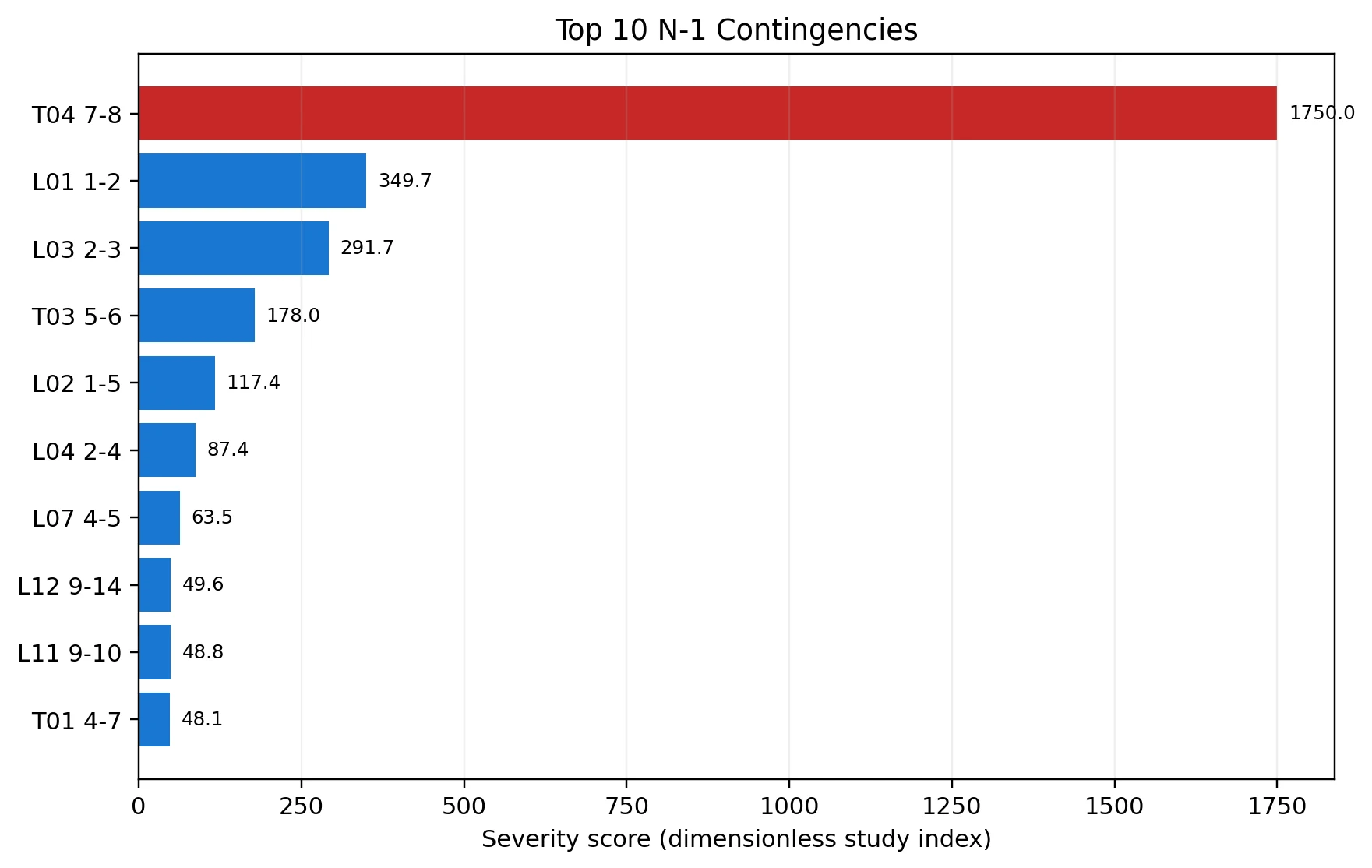
Figure 2Deterministic ranking from visible islanding, solution, voltage, loading, unsupplied-energy, and loss components.
Figure 3Selected connected cases show where lossless DC screening is useful and where nonlinear AC effects remain important.
Verification and testing
Two AC algorithms agree within 7.12×10⁻¹⁰ p.u. voltage and 3.74×10⁻⁸ degrees angle.
Generation minus demand minus losses closes to 3.55×10⁻¹⁵ MW in the verified run.