Motor Bearing Condition Monitoring from Vibration Signals
Physics-first vibration analysis using bearing kinematics, calibrated spectra, and Hilbert-envelope demodulation on CWRU data.
Public-dataset analysis
Automated test
Problem statement
Distinguish normal, inner-race, outer-race, and rolling-element conditions across two loads while keeping the evidence physically interpretable and avoiding same-record machine-learning leakage.
A reproducible diagnostic workflow that uses mechanical fault frequencies and demodulation before introducing a deliberately limited cross-load classifier.
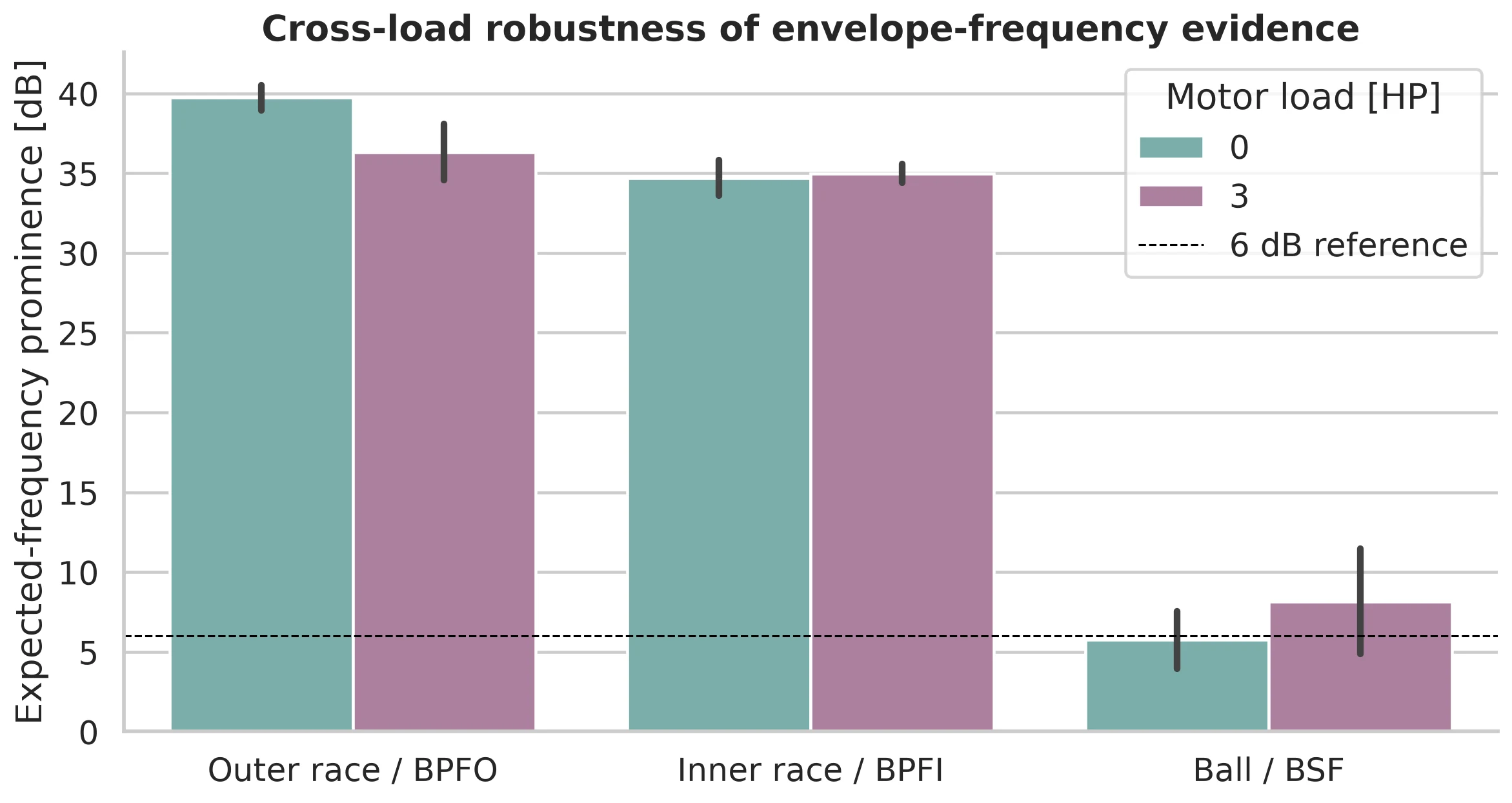
36.1-40.0 dB
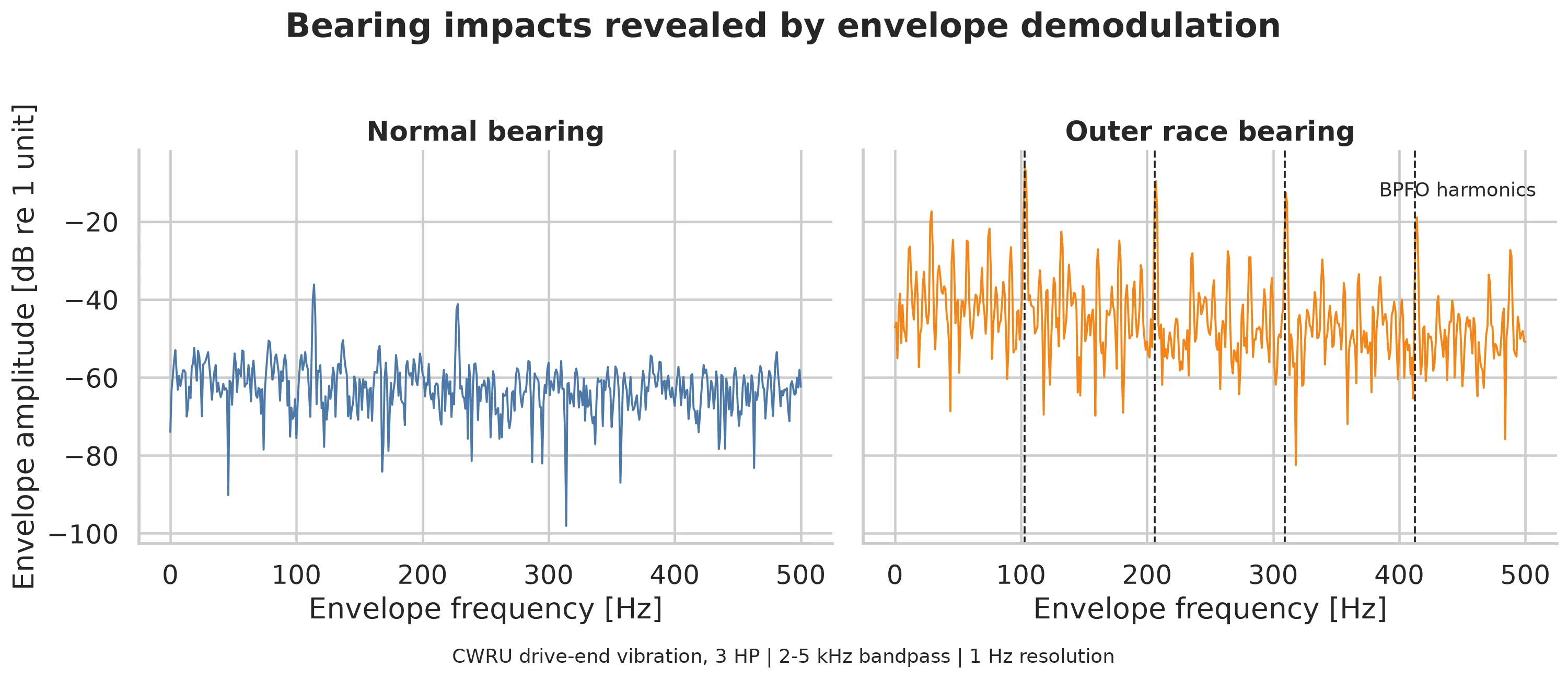
BPFO prominence
Median outer-race evidence across 3 and 0 HP
34.8-35.0 dB
BPFI prominence
Median inner-race evidence across 0 and 3 HP
5.8-9.9 dB
BSF prominence
Weaker, load-sensitive rolling-element evidence
82.5%
Cross-load accuracy
Exploratory; windows are not independent machines
Project scope
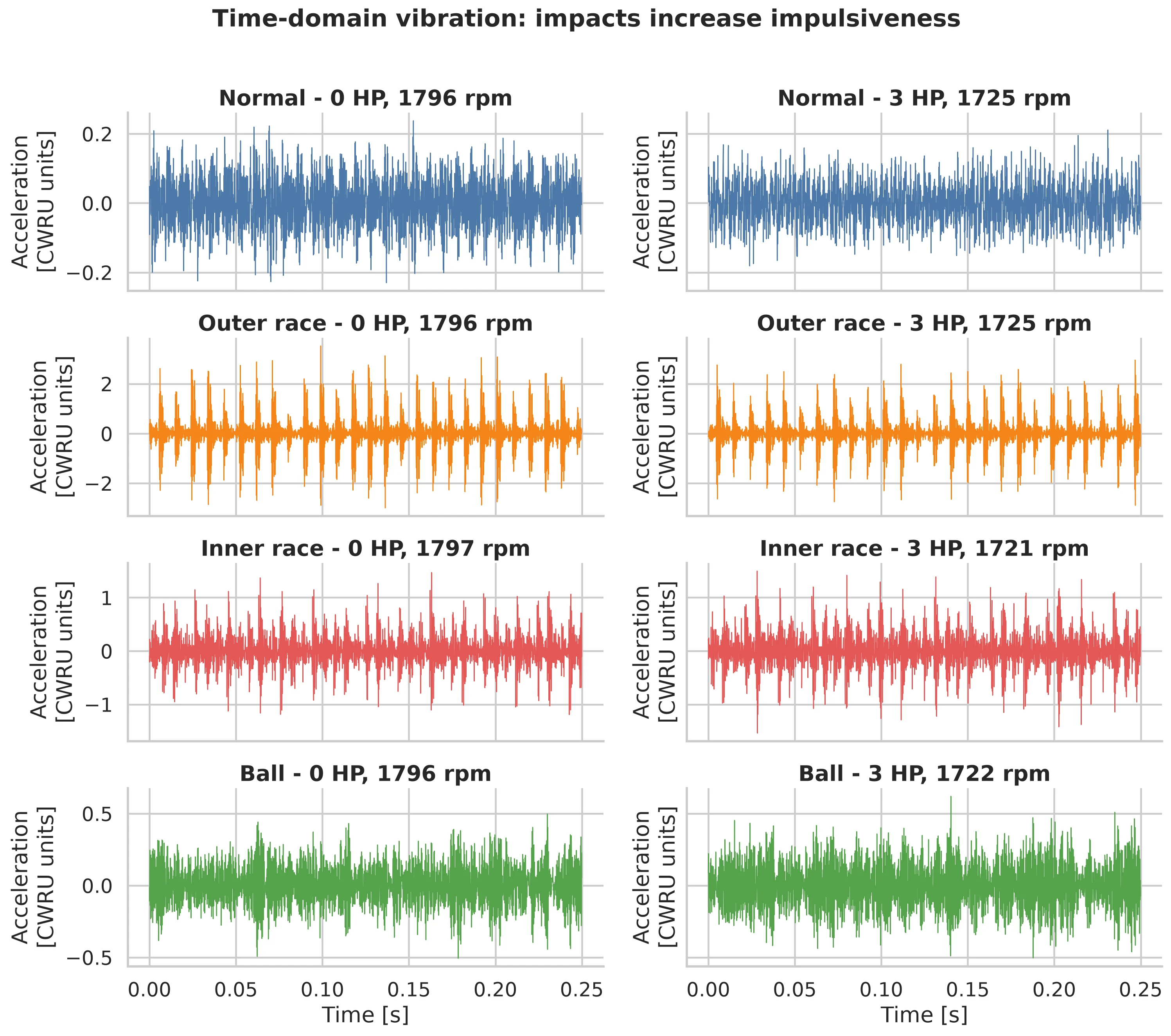
Eight official CWRU drive-end records covering four conditions at 0 and 3 HP
Smallest 0.007-inch seeded defects and five one-second windows per record
12 kHz common analysis rate, 1 Hz FFT resolution, and a fixed 2-5 kHz envelope band
Exploratory cross-load logistic regression after physics-based interpretation
System or processing architecture
Checksum-verified MAT files pass through channel discovery, offset removal, rate standardization, and segmentation. A parallel feature path computes time statistics while a spectral path calculates kinematic frequencies, raw spectra, resonance-band envelopes, and local frequency prominence.
My engineering contributions
Selected a controlled subset and encoded official record metadata, source rates, loads, speeds, and hashes.